I love knitting sweaters. I really do. But I hate knitting sleeves. Especially the second sleeve. It's like making mittens or socks but worse. Not only do I have to make two of them, I have to make two of them after making all the fun bits of the rest of the sweater. I know this is irrational. I could very easily make the sleeves first or separate them by making the sweater in between or make them two at a time. But it'll never happen. The sleeves must be made after the sweater. In my mind, that is the only logical possibility. So, I am left with the dreaded second sleeve. Which sometimes can mean that a sweater languishes in no man's land far longer than necessary.
This time, however, I have a more challenging problem. I am running out of yarn. I had 3 skeins of the stuff, which is plenty to knit a pullover in my size. It should have been fine. But for some reason (ahem, Honey) I decided to change my plans for the collar of the thing. I put on a shawl collar rather than my planned henley. It looks adorable but now I have this much sleeve:
And this much yarn:
(For reference, the Swiss Franc is about the size of the American quarter- definitely not enough yarn!)
Clearly I'm going to have to rip the collar for there to be enough yarn to finish the sleeve. But I don't want to believe this. In fact, it simply isn't true. If I knit faster, the yarn won't know what hit it and will magically stretch to the needed amount. It's a scientific fact. This is the converse black hole knitting effect. You know how you can knit for hours and hours and have no noticeable change in either the size of the ball of yarn or the sweater? This is the opposite. Knit at top speed, don't get discouraged and the sweater will grow, regardless of the amount of yarn left in the ball. This might be denial. But it's very well thought out and therefore must work.
Tuesday, November 29, 2011
Make Do and Mend - Jeans to Skirt Tutorial
I have a pair of jeans that I love. They always make me feel relaxed when I put them on. They fit well and they are a nice faded blue that can only be accomplished with years of wear. But they are falling apart. I've been wearing them for nearly ten years now and the holes in the crotch are getting so big that I risk showing the world my bits if I wear them in public. But I can't throw them out. They still have so much good wear left in them. For a while they lingered in my rag bag waiting for the perfect project to come and restore them to their former glory. Yesterday, I pulled out the sewing machine and decided that it was time for my jeans to live again.
I thought about patching them, so that I could wear them as jeans again but I didn't have any suitable material for patches and I thought I wasn't very likely to want to wear them out of the house with big patches in the crotch. So I figured I'd transform them into a skirt. I had made skirts out of old jeans in highschool but my approach wasn't very sophisticated. I had just split the inside leg seam and added a triangle of fabric. It worked and I wore those skirts all the time but they had a tendency to pop out in a strange way at the top of the triangle. It was like they had decided that since they couldn't be pants anymore, they would go in exactly the opposite direction of pants. So I came up with an alternative method which resulted in this:
It worked! I got something I can use again from my old jeans. I'm hoping I'll get at least a few more years wear out of this!
For anyone interested in recreating my results, I've put together a little tutorial.
Materials
Pair of jeans (they can be very worn but they should fit well and shouldn't have tears on the waistband area)
Scissors
Sewing Machine
Thread (I used a gold coloured thread to match the existing stitching on the jeans, but any colour will do)
Seam ripper or small, sharp scissors
Ruler or measuring tape
Tailor's chalk or pen or pencil
Pins (I didn't use them, but I'm a cheater)
Directions
Cut or rip open the inside leg seam of the jeans. If the seams are thick, you may need to cut off the seam so that only one layer of fabric remains.
Using a seam ripper, or small scissors, rip off the pockets from the back of the jeans. I only ripped them halfway off and left them hanging there, but this is optional.
Using a ruler or measuring tape, mark a line parallel to the waistband, about 5 cm below it. The line should run from about where the middle of each pocket was or about 20 - 25 cm long, with the crotch seam in the middle.
Cut off the cuffs of the jeans, taking off all ragged edges. Measure from the marked line to the cut off bottom of the jeans. mark the halfway point and cut here. If your jeans are worn through at the knee (mine weren't), you may need to cut out this portion of the leg that is worn. Make sure that the distance from the marked line to where you cut, is the same length as the lower leg portion of the jeans.
Mark from the line you made to the inside corners of the bottom of the skirt. Cut through the top layer only.

Draw a line of the same length that you marked between the pockets on the back of the skirt, parallel to the waistband about 2 cm below the zipper. Mark as you did for back of the skirt. Cut.
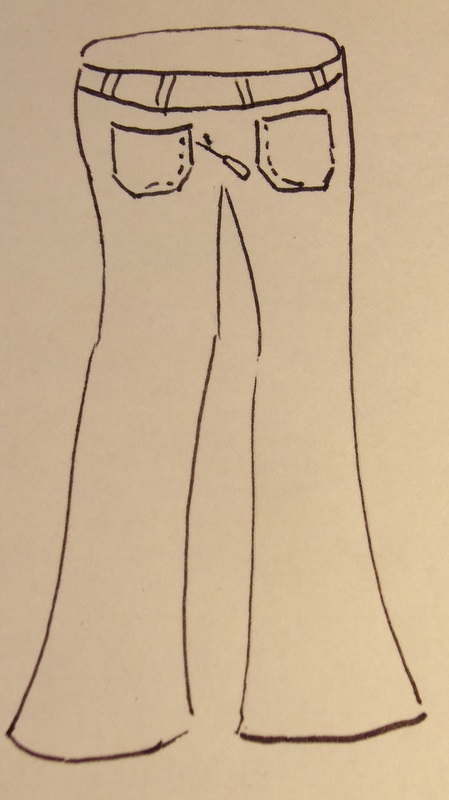
Here is where my drawing skills failed me, so you'll have to bear with me from here on in. Take one of the lower legs, open it and pin the shortest side to the top of the rectangle you cut out of the back of the jeans, matching seams, right sides together. Pin out to the corners of the rectangle, then pin the long sides of the lower pant leg to the long sides of the rectangle. You may need to clip the corners of the rectangle to do this. Do not worry if you have extra fabric in the corners of the rectangle. Sew. Turn to right side and press. Remove excess fabric from seam and edge stitch so that the seam lies flat. Do the same to the front. You will have excess fabric at the hem of the skirt as the rectangle cut out from the front is smaller. Apply pockets to the back. Using a zig zag stitch (or a serger if you have one), stitch the hem at the width of the presser foot. Turn up 1cm at the hem and seam using a regular stitch. Press and model!
I thought about patching them, so that I could wear them as jeans again but I didn't have any suitable material for patches and I thought I wasn't very likely to want to wear them out of the house with big patches in the crotch. So I figured I'd transform them into a skirt. I had made skirts out of old jeans in highschool but my approach wasn't very sophisticated. I had just split the inside leg seam and added a triangle of fabric. It worked and I wore those skirts all the time but they had a tendency to pop out in a strange way at the top of the triangle. It was like they had decided that since they couldn't be pants anymore, they would go in exactly the opposite direction of pants. So I came up with an alternative method which resulted in this:
It worked! I got something I can use again from my old jeans. I'm hoping I'll get at least a few more years wear out of this!
For anyone interested in recreating my results, I've put together a little tutorial.
Materials
Pair of jeans (they can be very worn but they should fit well and shouldn't have tears on the waistband area)
Scissors
Sewing Machine
Thread (I used a gold coloured thread to match the existing stitching on the jeans, but any colour will do)
Seam ripper or small, sharp scissors
Ruler or measuring tape
Tailor's chalk or pen or pencil
Pins (I didn't use them, but I'm a cheater)
Directions
Using a seam ripper, or small scissors, rip off the pockets from the back of the jeans. I only ripped them halfway off and left them hanging there, but this is optional.
Using a ruler or measuring tape, mark a line parallel to the waistband, about 5 cm below it. The line should run from about where the middle of each pocket was or about 20 - 25 cm long, with the crotch seam in the middle.
Cut off the cuffs of the jeans, taking off all ragged edges. Measure from the marked line to the cut off bottom of the jeans. mark the halfway point and cut here. If your jeans are worn through at the knee (mine weren't), you may need to cut out this portion of the leg that is worn. Make sure that the distance from the marked line to where you cut, is the same length as the lower leg portion of the jeans.
Mark from the line you made to the inside corners of the bottom of the skirt. Cut through the top layer only.
Draw a line of the same length that you marked between the pockets on the back of the skirt, parallel to the waistband about 2 cm below the zipper. Mark as you did for back of the skirt. Cut.
Here is where my drawing skills failed me, so you'll have to bear with me from here on in. Take one of the lower legs, open it and pin the shortest side to the top of the rectangle you cut out of the back of the jeans, matching seams, right sides together. Pin out to the corners of the rectangle, then pin the long sides of the lower pant leg to the long sides of the rectangle. You may need to clip the corners of the rectangle to do this. Do not worry if you have extra fabric in the corners of the rectangle. Sew. Turn to right side and press. Remove excess fabric from seam and edge stitch so that the seam lies flat. Do the same to the front. You will have excess fabric at the hem of the skirt as the rectangle cut out from the front is smaller. Apply pockets to the back. Using a zig zag stitch (or a serger if you have one), stitch the hem at the width of the presser foot. Turn up 1cm at the hem and seam using a regular stitch. Press and model!
Monday, November 28, 2011
Daydreaming
Today was for dreaming. Everyone has days like this when concentration is elusive and hours are lost to daydreaming and planning. I think that my daydreams are fairly common among crafty people. I dream of living with like-minded people simply. My sister and I jokingly call it the "cult farm". In this nice world we can indulge in our hippie ways and grow things, craft and live in a way that is less harmful to the environment, and ourselves.
I'm not sure whether this is really a common dream or not. I tend to surround myself with people who share my core beliefs, so my perspective may be skewed. Nevertheless I think that there are more and more people who are interested in this type of lifestyle, if not always for the same reasons. For some this is a religious thing. It isn't for me. For me it's partially about the real necessity of changing our lifestyles to prevent a climate catastrophe and partially about my desire to create a community.
When I think about the "cult farm", I think of several families living together and working together to live in a way that is (very nearly) self sufficient. I imagine a collection of small, energy neutral houses, a large garden, some animals, a studio for myself and the other crafty types, a workshop for those so inclined, and a larger building where we could get together to cook and share a meal. I picture no tv, but computers and internet to be used to make something of a living as well as books a plenty. It is a lovely daydream which I someday hope to make a reality.
I'm not crazy. I know that a lifestyle like that is a lot more work than my daydreams lead me to believe. And I know that I wouldn't be able to have the latest and greatest gadgets or even some of the things that many people would deem necessary. But that doesn't make it any less desirable to me. It doesn't have to be just like how I picture it either, but what I want is to find or create a community. As someone who is often alone (and enjoys it), this seems like an odd desire. Nevertheless it is what I really want.
It will take years to get there, I'm sure and the dream will evolve and grow as I do. But every once in a while I need to take the time to daydream and remember what it is that I really value and what my goals are. Cult farm, here I come!
Monday, November 21, 2011
Fine Yarns
Like most human endeavours, knitting is subject to fashion. It comes and goes in popularity generally and certain trends come and go within knitting as a whole. Like most fashion, knitting style is cyclical. Fun fur and boucle have come and gone and seem to be making a reappearance.
There are some trends though that seem to be here to stay. One of these is heavier weight yarns. It makes sense. Knitting was once not so much of a hobby as a way to provide a necessity and so people could devote more time to it. And even when it did become just a hobby people had more time to devote to it without the constant stream of technological distractions we have today. We have less time for our knitting but still we expect the same number or even more projects to be completed. It seems logical that we would turn to thicker yarns to solve the problem. They work up faster and they create warm garments with bold patterns.
Here's the thing about thicker yarns though: they make people look thicker. (In the physical, not the mental sense.) And in most cases, a pattern in thick yarn has all the subtlety of a hammer to the head.
Sometimes this is fine. A thick sweater for lounging in or a jacket that's meant to go over other layers should be thick. Bold patterns have a long tradition in outerwear. It just makes sense. But I think a subtler approach is better most of the time. If I think about "classic" fashion, in the sense of the ability of the look to stand the test of at least fifty years worth of time, it's not the bold patterns that stand out. The looks that today's designers tend to reference are about flattering shapes. Yes, there are certainly classic patterns but they are generally repetitive and reasonably subtle. Paisley, florals, houndstooth and some plaids come to mind.
I professed my love for sock yarn earlier and I think that my desire to create subtler, more classic looks has caused me to gravitate towards this thinner yarn. It allows me to make garments with smaller patterns, that fit closer to the body. Garments like this weigh less, are generally less expensive to make even in beautiful hand dyed yarns, and are fairly durable. They also take longer to knit. For those who are really in a rush to have something done RIGHT NOW, this is a problem. These are not instant gratification projects but for the knitter who is looking to keep a project going for longer because they enjoy the process, or want more knitting time for their money, it's a great option.
I love this kind of project. I'm currently working on a couple of them. Right now, it's a little brown sweater, it's going to have a henley neckline and set in sleeves. The caramel coloured wool is really doing it for me. I love how it looks like the bark of a tree. It's quite simple in construction but I think it will be a great addition to the wardrobe. Hopefully it will also be a successful pattern.
Friday, November 18, 2011
Stringent Requirements Must Be Met ... Or Else.
My requirements for purchasing sock yarns are fairly straightforward.
1. Warmth (not the challenging one, handknit socks are generally very warm)
2. Breatheability (must have high natural fibre content so that my feet don't turn my shoes into containers for large puddles of sweat)
3. Durability (at least superwash wool, preferably some sort of poly in there, tightly spun)
4. Colour (not a big challenge, I love all colours)
5. Price (get out of the 10 -15 EUR range and it has to be a very special yarn indeed)
The sticking points, particularly with yarns from the US, are generally durability and price. The trend seems to be for squishy yarns that are more loosely spun and very gentle. The kind of yarns you would want close to your face or neck. When poking around etsy and other indie internet shops I find a lot of silk or alpaca or cashmere blends and they all sound lovely. They also sound like if I knit socks or any other high use garment out of them they would crumble into tiny bits. I want durable yarn. I want what I make to be usable for years. So I go for the tough stuff. Tightly wound German sock yarns like Regia, Trekking or Opal are my faves. I know that lots of knitters think that they are "ropey" and have no give when you knit with them but I've never found that to be a problem. I find them enjoyable to work with.
The thing about these kind of yarns though is the colours. I love a good self striping yarn. I really dig stripey socks and the fact that the yarn does the work for me is fantastic and also strangely mesmerizing. But I tend to knit a lot of sweaters out of sock yarn so I'm looking for a less clown vomit look usually. I totally love the hand-dyed lines that opal and trekking do and there are a bunch of great indie dyers working with those bases particularly in Germany. I mean, who wouldn't love this, or this, or this. As an added bonus they are in my price range. Win!
Tomorrow I'm going to talk about things I knit with sock yarn. And yes, mostly they're sweaters. I do lead an exciting life.
Thursday, November 17, 2011
Procrastination
I enjoy most parts of the design process. Sketching, knitting, taking the pictures, the layout, writing the initial pattern are all things I enjoy. But there is one part of this work that I hate and because I hate it, I avoid it. I try everything to get away from having to do the dreaded sizing. I know that I shouldn't. I've learned from experience that procrastination only means that when you finally buckle down and do something you not only have to suffer through the pain of doing the dreaded task, you also feel guilty for not having done it earlier. Nonetheless, I still avoid doing the sizing on my patterns.
You would think that sizing wouldn't be the worst task. It's relatively easy and really only requires a basic understanding of human body shapes and simple math. But still it is the worst for two reasons.
First of all, it's tedious. It's the same math over and over again and it's not mentally challenging. It's about about the same amount of intellectual stimulation as filling out a spreadsheet.
Secondly, people freak out about sizing error, treating every error as a personal affront. To some extent I understand why people do this. The reason why many people knit or sew is to be able to create clothes that fit their bodies perfectly. Many people don't fit the mould when it comes to off the rack clothing. So I understand the frustration when the craft they have learned to be able to solve this problem fails them. I have even more sympathy for people knitting their first garment that come across this problem. Putting so much time, sweat and tears into a first sweater only to have it not fit is a dreadful situation.
That being said, I have read far too many forum and blog posts lambasting designers for simple errors. Even when the designer apologizes for making a mistake, I've seen people get worked up and portray the situation as one where the designer is against people of a certain body shape. Usually this means the shape that the designer or model isn't. This seems unnecessarily harsh to me. Yes, the clothing industry as a whole is skewed towards thin, tall women with boyish figures. Does that mean that all knitwear designers are morally opposed to women with other figures? No. Of course not. Beyond the fact that it is reprehensible to use people's physical appearance as a measure of their worth; as an independent designer that serves a community composed of people of all different shapes, sizes, ages and tastes coming out as someone who judges people for their body is like shooting yourself in the foot. It is a sure way to lose business.
We make mistakes in sizing because it's boring and we're human. Additionally most designers only have the resources to make one piece. In my case, I make the garment to fit me. This, in itself isn't really a problem. The problem happens during sizing because the fact of the matter is that sizing is an intellectual exercise and the further away you get from the actual garment and the human body for which it was designed, the more likely you are to make mistakes or to distort. Yes, designers should strive to make their patterns error free but mistakes are going to happen. When they do, it's best to correct them with as much grace as possible.
So what is the moral of the story here? Don't sweat the small, easily fixable stuff. And also I really should stop complaining and actually do some sizing.
Monday, November 7, 2011
Holiday Gifts
It's that time of year. The time when the intrepid crafter starts to think about what to make for their loved ones for the holidays. Well actually, it's the time of year when the crafter with not as much foresight as some of her co-conspirators starts to think about her holiday gifts. There are people who start months in advance. My mother has said to me on more than one occasion that she hates going shopping during the month of December. She really does plan out in advance to get at least the majority of her gifts before then.
As for myself, I think that I am not doing too badly. I hate shopping for gifts. This is mostly because I hate shopping generally. Except grocery shopping, that I can handle. So instead I am making gifts. Or looking online for the tough cookies. Fortunately for me, Honey's family are easy. I'm cooking Christmas dinner so I'm off the hook for gifts. My family, I don't know yet.
But I have made some headway on my gift for Honey. I'm knitting a sweater. I know you're not supposed to knit for a man until you've got a ring but I think that's a lot of hooey. And if it isn't hooey, then I think that only horrible sweaters that the knitter hates making and the giftee hates wearing can really cause the curse to come true. My sweater will be neither of those things.
Observe:

The sketch complies with his needs and mine. His needs are very specific. It must be a pullover, without too much patterning. It needs to have a collar that comes up around the neck. I need it to have at least a few things going on so that I can knit it without getting too bored halfway through and giving up on the whole project.
The "swatch", by which I mean the patterned band around the centre of the sweater, has been a success. I am enjoying knitting it and it's dense enough to pass muster.
Yes, it's purple. The photo is a little more luminous than the actual colour (that will teach me to wait until after dark to take pictures) but it is purple. I know that there are men out there who reject wearing purple but Honey isn't one of them. He looks good in purple and so it makes the accepted color list. Thank goodness. I'm not sure I could handle making a plain grey sweater in that size!
As for myself, I think that I am not doing too badly. I hate shopping for gifts. This is mostly because I hate shopping generally. Except grocery shopping, that I can handle. So instead I am making gifts. Or looking online for the tough cookies. Fortunately for me, Honey's family are easy. I'm cooking Christmas dinner so I'm off the hook for gifts. My family, I don't know yet.
But I have made some headway on my gift for Honey. I'm knitting a sweater. I know you're not supposed to knit for a man until you've got a ring but I think that's a lot of hooey. And if it isn't hooey, then I think that only horrible sweaters that the knitter hates making and the giftee hates wearing can really cause the curse to come true. My sweater will be neither of those things.
Observe:
The sketch complies with his needs and mine. His needs are very specific. It must be a pullover, without too much patterning. It needs to have a collar that comes up around the neck. I need it to have at least a few things going on so that I can knit it without getting too bored halfway through and giving up on the whole project.
The "swatch", by which I mean the patterned band around the centre of the sweater, has been a success. I am enjoying knitting it and it's dense enough to pass muster.
Yes, it's purple. The photo is a little more luminous than the actual colour (that will teach me to wait until after dark to take pictures) but it is purple. I know that there are men out there who reject wearing purple but Honey isn't one of them. He looks good in purple and so it makes the accepted color list. Thank goodness. I'm not sure I could handle making a plain grey sweater in that size!
Subscribe to:
Posts (Atom)